How Do You Choose Between Nvidia and AMD for Gaming?
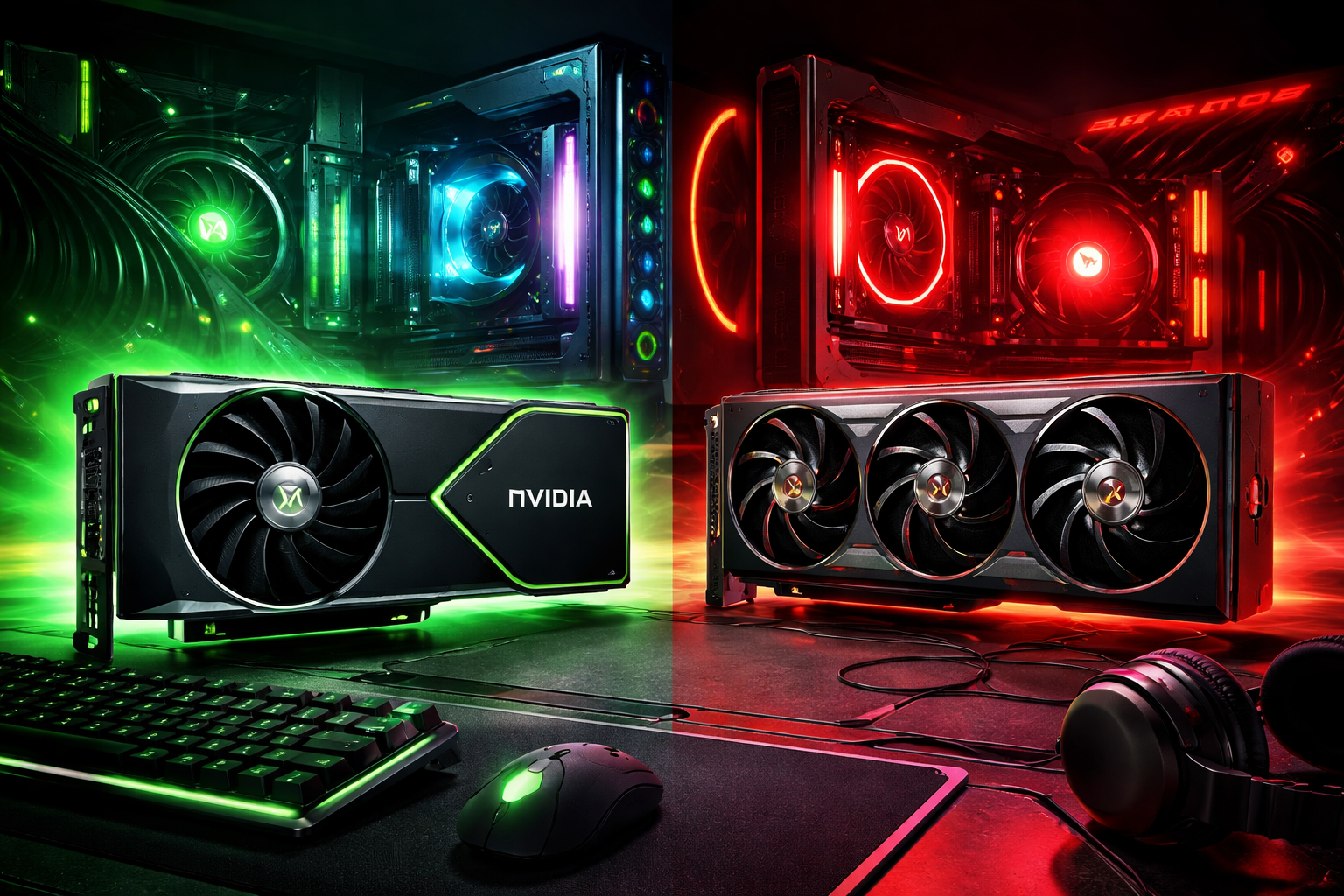
So, you’re building your own gaming PC and you’re stuck at the ultimate battle: Nvidia vs. AMD. It’s similar to choosing between pizza and hamburgers. Both are delicious but which one will suit your tastes (and the budget)? Let’s break it in the most simple way without the jargon of technology terminology.
Takeaways
- Nvidia = Power & Features, but it costs more.
- AMD = Great Value & Efficiency, especially for mid-range and budget gamers.
- Ray tracing & DLSS are Nvidia’s strengths.
- FreeSync (AMD) vs. G-Sync (Nvidia) – check what your monitor supports.
- Gaming laptops? Go Nvidia.
- For upcoming PC game releases, either brand will handle new titles just fine.
- Don’t overthink the CPU-GPU pairing – pick based on price and performance.
- Your electricity bill might hate Nvidia’s top GPUs.
- Future-proofing? Nvidia’s high-end cards have better longevity.
- PC gaming trends keep evolving, so choose what works best for YOU right now.
1. Budget – Because Money Matters
If you’ve got money to burn and are looking for the very top, Nvidia’s premium cards are of the highest quality. However, if your pocket is aching at the end of its tunnel, AMD offers some fantastic affordable options. Consider Nvidia as the brand that is designed by designers and AMD as the reliable and affordable option that is stylish.
2. Performance – Who Wins the Race?
Nvidia typically is the leader in performance, particularly in the ray tracing process and AI-powered upscaling. Its DLSS (Deep Learning Super Sampling) technology improves performance in challenging games. Additionally, AMD isn’t too far behind. Their latest GPUs provide excellent performance particularly at 1080p and 1440p resolutions.
3. Ray Tracing – The Fancy Lights
Are you looking to make your games look real-like, just as if they were the look of a Pixar film? Nvidia offers better ray-tracing capabilities. However, if you’re not concerned about the way shadows look, AMD’s ray-tracing performance is nevertheless good (and typically less expensive).
4. Upscaling – Making Things Look Pretty
Nvidia’s DLSS is top of the line, making games more smooth when you use higher resolutions. AMD’s other alternative FSR (FidelityFX Super Resolution) is great, however it’s not like comparing a 5-star restaurant with an average eatery. Both are great but one is slightly more expensive.
5. Power Consumption – Your Electricity Bill Will Notice
Nvidia cards, particularly those with high-end features are powerful beasts that consume a lot of power. If you’re looking to cut down on power (or not turn your PC to a mini-heater) AMD’s efficiency is higher for mid-range models.
6. Gaming Laptops – Nvidia Dominates
If you’re considering Gaming laptops, Nvidia will be the top option. The GPUs they use are much more popular and DLSS ensures that your laptop won’t break sweat when playing intense games. AMD laptops are on the rise however they’re not as accessible.
7. Software & Drivers – The Hidden Battle
Nvidia offers more refined software and drivers, which includes regular updates and improved game optimizations. AMD was once a company with an unreliable history with drivers; however, they’ve made significant improvements. However, Nvidia wins here with greater support for developers.
8. Compatibility – Does It Matter?
Many people believe AMD GPUs are better suited to AMD CPUs, but in reality it’s not making an enormous difference. No matter if you’re running either an AMD or Intel processor the Nvidia as well as AMD GPUs are able to work. There is no reason to be overthinking it.
9. Future-Proofing – Think Ahead
If you’re looking to have your GPU be able to stand the test of time for a few years, Nvidia’s top-end models tend to last longer particularly with advanced features, such as DLSS and enhanced driver support. If you are a frequent upgrader AMD’s cheaper choices are more appropriate.
10. The Final Verdict – It’s All About You
If you’re looking for the most powerful performance for your budget, Nvidia is the winner. If you’re looking for excellent performance but don’t break the budget, AMD is a fantastic option. In the final analysis, both firms produce fantastic GPUs. All you have to do is decide which one best fits your requirements and budget.
FAQ
-
Nvidia wins in high-end performance, but AMD offers better value for budget gamers.